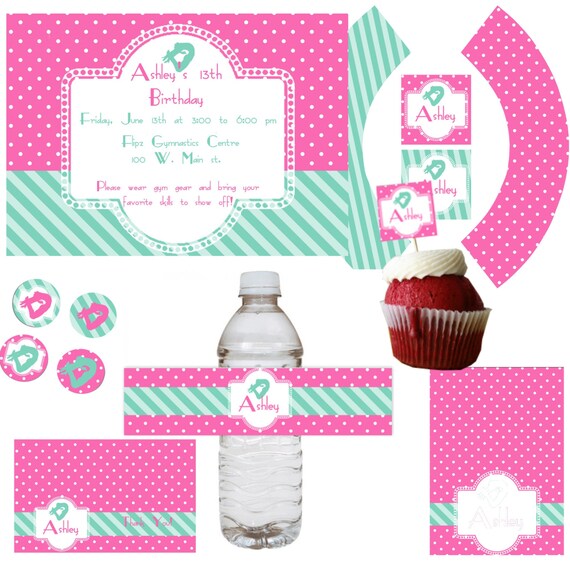
This is one of my latest designs that is available for customization via my etsy shop.
Birthday's & a HUGE announce ment!
Friday, June 7, 2013
This is one of my latest designs that is available for customization via my etsy shop.
Life of the Hashtag #Gymnastics
Thursday, February 14, 2013
Gymnastics Word Cloud: Awesome Find!
Monday, February 11, 2013
Quick Tip to Improve your Gymnasts Speed
Lately, I’ve been taking into consideration the main points of Mr. Takashi Kobayashi from our sharing session when creating lesson plans. A co-worker always reminds me, first they need the speed and power…and he says it in his awesome Chinese accent that gets me fired up. After going over my resources, I’ve come up terribly short when it comes to training speed, agility and quickness. youth speed training agility quickness strength speed coach workouts
- Lean how to incorporate balance, stretching, and movement that will have your athletes warmed up, breathing, sweating, and prepared to play at game speeds in less than 10 minutes.
- Learn why progression is king for athletic development and how performing advanced exercises too soon will result in your athletes peaking too soon.
- Do your athletes have a tryout coming up soon where being faster and quicker may mean the difference between making the team or not?
- Learn how to properly and safely develop explosive power based on the athlete’s age and maturity using only a medicine ball.
- Learn how to use the agility ladder drills properly. What 99% of coaches don’t know that could be hurting your development.
The Natural Process of a Gymnastics Coach
Friday, February 8, 2013
If you are searching for the best tools out there to become a gymnastics coach, you may find some useful resources online or in a book and through attending various courses and workshops. Sorry to say, that neither of them make one an extraordinary teacher. What separates the best from the rest is a coach that is also a teacher who is a brilliant facilitator that carries their learners to succeed.
When we look at the phases a coach goes through in our line of business, there are four distinctive phases, in each one a coach may have that key moment when arriving at the other advancement in their career. This natural process of a gymnastics coach will not be found in yours or mine resume or CV but rather it is in our intrinsic development.
Newcomers to the coaching world think in terms of the entirety of a skill; they teach gymnastics skills. They really only think in terms of teaching the skill at that point in time and that’s really all that they want to achieve. In spite of this, there are frequent setbacks when these newcomers teach the skill. (Ever try to teach a new kid a cartwheel with absolutely no preparation? Yes, me too…when I was starting my coaching career.)
At that time, coach becomes more conscious about the skills problems and aims to resolve the problem areas in the skill. Still, when making the effort to fix the skill there comes numerous problem areas in technique, lack of strength or flexibility or power. The majority of the time, these are not solitary problems but go hand in hand with one another.
Then, the gymnastics coach will think of the primary root of the skills and the components of each factor. They decipher each gymnastics skill, think of the essentials and set in motion their transition into the last stage of the natural process.
At last, they look at the entity. They look at each individual gymnast and realize they are teaching them how to do gymnastics. Each and every one of their gymnasts has special qualities accompanied by their personal flaws. In parallel, these coaches giving these gymnasts triumph from the very beginning in segments so that these gymnasts will be proven proficient each step of the way until they accomplish the skill.
This natural process, is something one would say, “You have to go through it yourself.” I can’t tell you to stat thinking in terms of the individual and their needs compared to another student in your class. Nor can I give you all the answers. In spite of everything, there are tools for you to speed up this process.
Next week I’ll post about skill decomposition and you can take a bite off that learning curve. Follow this journey, you never know what you’ll learn through the process.
Just like "Top Model"
Thursday, September 13, 2012
The model, Diana, was an experienced in pilates but she had never been on a trampoline before. We started out with some routine familiarization exercises like walking, moon-walking, doing the "type-writer"and long jumps. Then we moved on to starting and stopping with safe-landing techniques. As she found herself more confident, I introduced star jumps (her favorite), tuck jumps and modified stretch jumps with different arm positions. Soon, it was off to hair and make-up for her and set-up for the rest of the crew.
Jumping on the trampoline may come easy for many of us but when you get a handful of people around, super bright lights and, oh yeah, cameras rolling, it brings in another level of professionalism. I gave a little show to the crew bouncing around, yes it was fun but I give the upmost respect for this model who did an amazing job! She had safety in mind, kept her cool and showed how beautiful one can look from one bounce to the next.
Retirement Planning; Life After Gymnastics
Wednesday, May 23, 2012
Mention the word retirement to non-gym people an they wouldn’t instinctively think of a teenager or preteen moving on from their gymnastics career but rather someone in the 60's moving to a subtropical climate to live off their pension. Retirement is not only a major life-changing event for those leaving the workforce but also for a teenager. Infant, considering their delicate emotional state, this IS the biggest event of their life to dateso far.
Gymnasts are accustomed to goal setting, working hard towards that goal and eventually manifesting that goal. There is definite certainty of this sport where it would be easy to feel lost without a purpose when leaving the gym. Retirement gives an opportunity for psychological growth when the gymnast’s exclusive identity as the gymnast explores their identity of who they are outside of the gym.
In addition, the planning process is the beginning of asserting personal control and achieving independence. Coaches have always told or showed them what to do and how to do it. This “freedom” can end up being a struggle to adjust to the new independence brought by retirement. Finding new hobbies, extra-curricular activities and other past-times can come into play. Before they have always had to sit on the backburner. Take this time to research all opportunities. Talk to people who do them or better yet sign-up for a trial class.
Furthermore, this time is another opportunity to find connections with friends inside and most importantly, outside of the gym. As a woman comes to identify herself with the relationships she has with others. Find connections to those outside the sport and form new friendships.
As most gymnasts retire during adolescence, it is inevitable physical changes will be associated with the ending of training. Plan to keep the body active, try other sports or dance. While the pressure to be in the best shape for competition may be relieved, a healthy active lifestyle should not be neglected. It’s quite easy to gain 10-15 lbs in a month with no gym, believe me; I’ve been there!
To sum it up:
- Finish the season
- Find a hobby
- Make new friends
- Plan a way to stay active.
What to do when they want to quit?
Friday, May 18, 2012
Happy Mother's Day: A Tribute to Mommy & Me
Saturday, May 12, 2012
Once upon a time an overactive 2 year old was taken to a Mommy & Me class at her local club. She instantly fell in love with the sport, dedicated her life to it without realizing she had dedicated her mothers life to it too. From those early movement classes to the very last competition of her career, it was always Mommy & Me.
- Mommy was the chauffeur to and from gym, even when she could have done something nice for herself.
- Mommy cleaned the gym every week at 4 am in exchange for the many hours of training.
- Mommy was the ambulance when things went wrong on a tumbling pass.
- Mommy was screamed at because, "she just didn't understand."
- Mommy was the cheeleader when there wasn't so much cheer.
- Mommy was the stylist making sure she had sewn the right leotard pattern.
- Mommy was the gym's interior decorator bringing life and color to the meets.
- Mommy said, "it's OK," when it was time to hang up the grips with dignity.
28 years later that little girl becomes a mommy hoping one day to have a class: Grandma, Mommy & Me.
Gymnastics has given me this unequivocal bond with my mother that I've never heard of with any other sport. Happy Mother's Day!
Gymnasts, ex-gymnasts: Please share your stories of how your mother influenced your gymnastics.
Fun With Scarves
Saturday, May 5, 2012
The Effectiveness of Using Educational Gymnastics skills on Motor Capabilities and Social Behaviour among Kindergarten children
Thursday, May 3, 2012
It comes as no surprise to me that "Results indicated that motor capabilities, balance, agility, strength endurance; flexibility, explosive power, and muscular endurance improved significantly in the experimental group.Differences were also found between experimental and control groups with regard to social skills and problem behavior according to parents and teachers reports. Gender differences were noted in connection with motor capabilities, social skills and problem behavior. Significant relationships were found between motor capabilities and social behavior. Left-handed children had better reaction times than right handed."
What I found most unique about this study was it seems there was no coach in this study. The researcher designed a program that would was age appropriate with the purpose of improving basic gymnastics skills, loco-motor skills and social skills. The program was recorded on 31 DVDs of other gymnasts (aged 4-10). Each lesson was split into 3 sections: warm-up, the workout, and cool-down. It was an audio-visual program where, they watched and did with their regular school teacher.
If these children are simply imitating a screen, imagine how much more of a significant impact on the differences between the control group and the experimental group were to be if I were coaching them? I would like to see future prospects of a study like this conducted with great coaches!
I love seeing these types of studies done to really drive in to my heart that what I'm doing is really making a positive difference in a young child's life.


